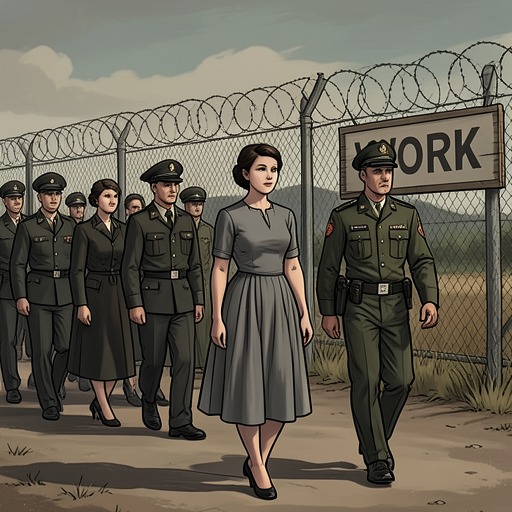
Alisz Seisser’s abortion procedure
The Zone of InterestAlisz Seisser’s abortion procedure is a clandestine medical intervention arranged by Paul Doll, who presents it as routine care while controlling both the prisoner and the doctor required to perform it. The scene turns a procedure conducted with instruments, boiling water, and local anesthetic into an enactment of camp power: Doll offers reassurance, bargains with cigarettes, and makes the patient’s survival part of his leverage. He ultimately stays through the operation, discovering that the squeamishness he expected to feel is absent.
Circumstances and Unequal Power
At Doll’s regular visit, Alisz is crouched on a stool, her hands slowly writhing in her lap. He tells her to stop moaning and insists that he has spoken to a physician and that the procedure is simple and routine. Alisz points out that there are no women doctors there. Doll replies that there are hundreds, identifying them as prisoners. His answer recasts the camp’s imprisoned medical workforce as a resource available to him, while doing nothing to address Alisz’s fear or the circumstances that have left her dependent on his assurances.
Doll later attempts to reassure her at closer quarters, seating her beside him on the bed and asking whether she feels better. Alisz thanks him and says he always finds an answer. The scene’s apparent intimacy is inseparable from their unequal positions: he is the commandant, and she is a prisoner under his control. His own narration makes the contradiction especially stark. He describes his usual scruples around a pregnant woman retreating, urges Alisz to lift her clothing, and has sex with her; he then presents his engagements with her as necessary to preserve his dignity and self-respect. The episode therefore does not establish the circumstances of her pregnancy, but it does show Doll converting his authority and her dependence into a private sexual relationship that serves his self-image.
The Bargain with Miriam Luxemburg
Doll summons Miriam Luxemburg, a Polish-German prisoner who has been in the camp for two years. His description records the bodily effects of deprivation: she appears about fifty though probably about thirty, with badly altered hair and lips, but retains some flesh and seems comparatively clean. The contrast between her condition and the medical expertise he needs places the proposed operation inside the same system that has damaged the people expected to carry it out.
Doll says security requires the procedure to take place around midnight and asks what Luxemburg will need. She requests clean towels and plenty of boiling water. When he assumes she will administer one of the pills he has heard about, she specifies that the procedure will be dilation and curettage. His matter-of-fact response that the doctor should do whatever is necessary does not amount to trust: he immediately warns that the directive may change, and suggests that orders from Berlin could produce a different outcome in which the procedure does not go well for the patient.
The exchange is also a negotiation over material aid. Doll’s initial offer of six bread rations is rejected. He then gives Luxemburg a paper bag containing two sleeves of Davidoffs, with two more sleeves to follow, making 800 cigarettes. She intends to use this capital for her brother, who is struggling in a penal labour unit in the uranium mines beyond Fürstengrube. When Doll renews the threat, he offers a further 800 Davidoffs. The cigarettes are thus neither incidental payment nor a neutral gift: they are aid Luxemburg can use for her brother, offered within a bargain backed by Doll’s capacity to threaten the patient’s life.
Doll makes the threat explicit by naming sodium evipan or phenol and describing a cardiac injection. He invokes Luxemburg’s participation in prisoner selections and the disposal of live births, using her forced involvement in the camp’s medical violence to pressure her into compliance. The scene does not present the doctor’s earlier actions as proof that she has freely accepted Doll’s terms. Instead, his appeal to that complicity becomes another instrument by which a commandant secures the work he wants.
The Midnight Procedure
The operation is repeatedly deferred before it begins. When the appointed time arrives, Luxemburg unfolds a portable stand resembling a miniature operating table and lays out a syringe, speculum, clamp, and a long wooden instrument ending in a sharp, crenellated metal loop. Doll judges the instruments to be of reasonable quality, better than equipment that SS doctors sometimes have to use. His attention to the tools makes the procedure concrete even as he tries to keep the scene at an emotional distance with inconsequential talk about spring.
Alisz lies on a stripped cot padded with towels, wearing a white singlet, her knees raised and legs apart. A leather thong is in her mouth. Luxemburg estimates that the procedure will take twenty minutes if it goes smoothly, and Doll relays this estimate to Alisz as reassurance. His cheerful manner does not alter the patient’s exposure or make the operation voluntary; it instead places a light, administrative gloss over a scene in which Doll has arranged the time, secured the doctor, and threatened the possible outcome.
Doll says he intended to leave as soon as the procedure began because he was fastidious about women’s bodies. Instead, he remains while Luxemburg applies cleansing solution and injects a local anesthetic, stays through dilation with the speculum, and watches the curettage. He searches himself for squeamishness and finds none. That absence is a decisive change in the scene: the operation does not drive him away or confront him with the response he expected. His claim of fastidiousness yields to prolonged observation.
Aftermath and Significance
Afterward, Doll drives Luxemburg back to the Hygienic Institute and hands over an additional 400 Davidoffs. He asks how long it will take before Alisz is her old self again. The question looks toward recovery, but the account gives no answer about how Alisz fares afterward. What it records instead is Doll’s continued management of the doctor through payment, even after the procedure is over.
The episode joins several forms of camp power without treating them as separate spheres. Prisoner medical labour, the threat of killing by injection, the circulation of cigarettes as leverage, and Doll’s sexual access to Alisz all operate within the same relationship of command and dependence. His language casts the operation as routine and his intimacy as necessary to his dignity; his actions expose the coercion beneath both claims. The scene’s ending offers no resolution for Alisz, only Doll’s question about her return to her former self and the practical gesture of paying Luxemburg for work performed under threat.